



Cannabis retail and distribution are consolidating, whether market participants want it or not.
Active US cannabis business licenses have declined for seven consecutive quarters.
Surviving operators are absorbing the volume of those that left, and Vireo Growth’s agreement to acquire Planet 13 Holdings, announced in late July 2026, would on completion of that and other pending transactions, produce a retail footprint of roughly 265 dispensaries across 15 states.
Brands and cultivators are selling to fewer counterparties, each one is getting larger, and that is good for the long term health of the industry.
Cannabis has lacked scaled operations, compressing margins and disrupting payment throughout the supply chain. Consolidation brings fewer stops and bigger drops, real forecasting, purchasing organizations that behave professionally, and lower cost to serve. Cannabis is getting all of that.
What cannabis is not getting is a pricing benefit and the reason runs deeper than price. In several major markets the licensed channel captures a minority of what consumers actually consume, roughly 40% of in state consumption in California and something near 16% of estimated demand in New York.
Consolidation inside a minority channel does not deliver the pricing power that consolidation normally delivers, and it makes each large buyer far less replaceable than a store count suggests.
Meanwhile the other half of consolidation is arriving on schedule.
Receivables concentrate. Terms stretch. The option to walk away from a slow payer narrows, because the slow payer is now a fifth of the book. And when a consolidated buyer fails, it does not take down one supplier; it takes down a dozen at once.
Mainstream consumer packaged goods went through all of this and survived.
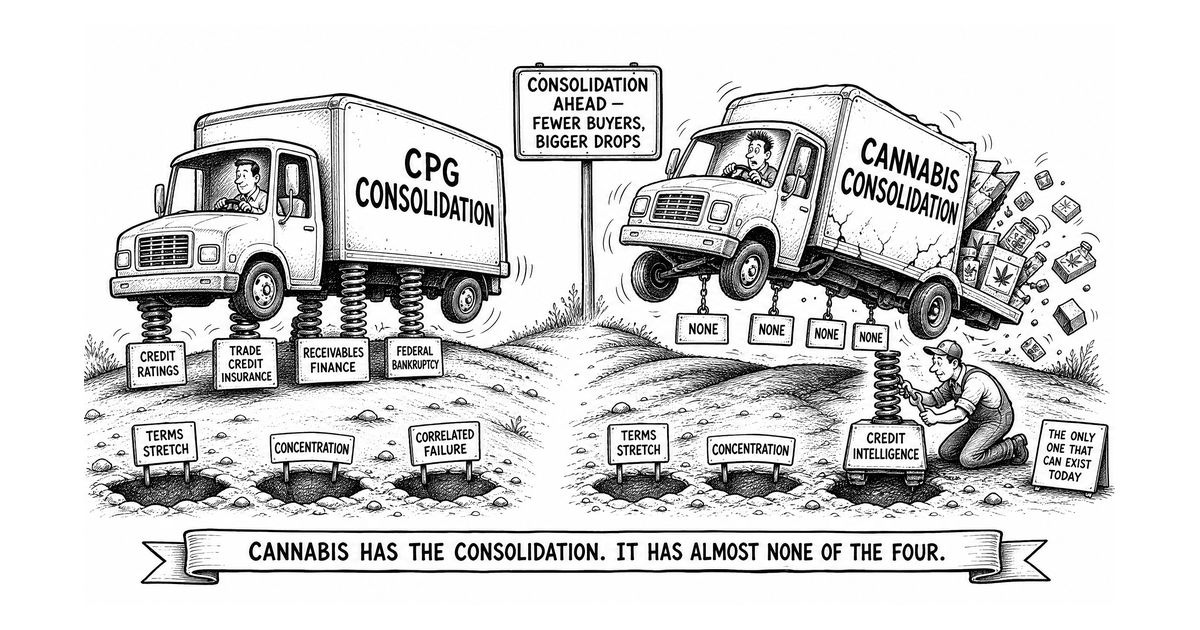
Arguably, it survived because risk infrastructure grew up alongside the consolidation: commercial credit information and ratings, trade credit insurance, factoring and receivables finance, and the priority and process rules of federal bankruptcy.
Each absorbs part of the shock that consolidation transfers from buyer to seller.
Cannabis is getting the consolidation but still has almost none of the four.
And of the four, credit intelligence is the only one that can exist in this industry today, because unlike the other three it does not require a federal counterparty, a rated buyer, or a bankruptcy court.
Where the precision of credit intelligence is absent, something else fills the vacuum. Usually a regulator, holding a blunt instrument.
Part One. What Is Actually Happening
The consolidation
Licensing counts have been contracting for years. Industry tracking indicates total active United States cannabis business licenses fell approximately 1% in the first quarter of 2026 to roughly 36,169, the seventh consecutive quarterly decline, extending a nearly unbroken contraction that began in Q4 2022.
Established markets including California, Oklahoma, and Michigan continue to shed licensees, and Ohio moved to a 400 dispensary cap in early 2026.
Retail is scaling into larger platforms. Vireo Growth entered a definitive agreement to acquire Planet 13 Holdings. On completion of that transaction together with Vireo’s other pending deals, Vireo expects to operate roughly 265 dispensaries across fifteen states, placing it among the largest United States operators by store count.
That is a single purchasing counterparty of a size that did not exist in this industry a few years ago.
The economics underneath are unforgiving. Whitney Economics survey work has repeatedly found profitability far below the broader economy. While now a bit aged, its Q422 operator survey put the share of profitable United States cannabis operators at 24.4%, against roughly 65% of small businesses generally, and a subsequent survey put the figure at 27.3%.
Both readings rest on samples of a few hundred respondents, and the 24.4% number is now widely recirculated in current statistics roundups without its original date. We would treat the direction as reliable and the precision as not.
Wholesale flower pricing has compressed substantially since 2021 across most legal markets, though it has seemingly begun to stabilize more recently. The Cannabis Benchmarks United States Spot Index stood at $1,050 per pound on August 7, 2026, having recovered from a record low near $888 in January 2025.
Illinois adult use retail sales declined roughly 12% in 2025 to about $1.5b from $1.7b in 2024, even as units sold rose from roughly 49 million to 52.1 million. The decline is attributed principally to price compression, competition from hemp products and taxes, with cross border purchasing in Michigan and Missouri a contributing factor.
More product moved for less money.
So the mechanism runs as it does in any consolidating industry.
Weak operators exit.
Survivors absorb their volume.
The number of counterparties a brand or cultivator sells to falls, and the size of each rises.
It is worth being clear about who is doing the work.
Consolidation in cannabis is not something happening to the industry. It is being led by operators who’ve built professional purchasing organizations, multi state logistics, real inventory planning, and access to capital in a sector where capital is expensive and scarce.
Those capabilities did not exist in this industry five years ago, and the operators who built them are the reason a brand can now forecast a quarter instead of guessing at one. Every efficiency exists because somebody invested in building it under conditions that made building it hard.
It is also worth noting that the largest operators sit on both sides of this.
A vertically integrated company is a buyer in the states where it retails and a supplier in the states where its wholesale arm sells into retailers it does not own. It carries a receivables book of its own, and it inherits a counterparty’s payment reputation and open AR when it acquires one. Horse trading receivables vs. payables feels like a protective moat, but without a contractual right to offset, the risk actually compounds.
So the issues facing small suppliers impacts the larger operators as well.
The market the consolidation is happening inside
In a normal consolidating industry, share is measured against total category demand.
A grocery chain holding 22% of a metro area holds 22% of the groceries people there actually buy. In several major cannabis markets that assumption doesn’t hold, because the licensed channel captures a minority of what consumers actually consume. The denominator is wrong, and it is wrong by a lot.
California is the largest legal market in the country and the clearest illustration.
In the California Cannabis Market Outlook prepared by ERA Economics for the Department of Cannabis Control, licensed operators supplied approximately 1.4m pounds of the roughly 3.8m pounds of cannabis consumed in the state in 2024.
That is about 40%, with the unregulated market supplying the remaining 2.4m pounds. Separately, and this figure should not be set directly against licensed retail because much of the volume likely leaves the state, the same work estimates roughly 11.4m pounds of unlicensed production annually at a wholesale value near $11.9b.
That 11.4m figure is the midpoint of a wide confidence interval running from 7m to 16.3m pounds, and ERA states it believes the true number is likely closer to the lower end. The licensed comparison is against $1.03b of licensed wholesale value in 2024.
New York is further out. The Office of Cannabis Management reported 519 open dispensaries as of November 30, 2025, roughly $1.06b in adult use sales during 2025, and approximately $2.5b since the market opened.
One independent analysis, working from a total addressable market estimate of roughly $10.73b, puts legal capture near 16%, which would place the unregulated market above $9b annually.
That capture figure is a third party estimate rather than a state published number, and the total addressable market underneath it is itself modeled. Other estimates run higher: daily legal sales averaged about $5.14m in April 2026, and some observers put illicit daily volume as high as $50m, which would imply capture closer to 10%.
Enforcement has been picking up but not really moving the denominator. Approximately 1,500 unlicensed storefronts were padlocked in 2024, but reported seizures amounted to less than 1.6% of a single year of illicit supply.
Oregon reaches the same place by a different road.
Legal sales peaked around $1.2b in 2021 and had fallen to roughly $925m in 2025.
The Oregon Liquor and Cannabis Commission’s 2025 supply and demand report found demand equal to roughly 57% of actual annual supply on the measure most widely reported, producing record low retail prices.
The same report states a wet weight equivalent figure of 71%, so the precise ratio depends on which measure is used.
Legal channel share of all cannabis sales in the state fell from about 75% in 2020 to about 68% in 2024 per Whitney Economics.
Oregon has spent roughly $46m over seven years on illicit market enforcement, and the Oregon Criminal Justice Commission has acknowledged it cannot draw conclusions about whether that spending reduced the illicit market’s scope.
Market
Licensed channel share
Basis and driver
California
About 40 percent of pounds consumed in state, 2024
1.4 million of 3.8 million pounds. Substitution by unregulated supply.
New York
About 16 percent of estimated demand.
1.48 billion dollars retail against a 10.73 billion dollar estimated addressable market. Substitution.
Oregon
About 68 percent of sales in 2024, from about 75 percent in 2020
Licensed oversupply. Demand at 57 percent of annual supply in 2024.
Licensed channel share of the cannabis actually consumed in three major markets. Figures are drawn from the sources listed at the end of this paper and are not directly comparable to one another, because each state measures a different quantity.
Three things follow, and they are actually credit conclusions rather than policy ones.
First, the ceiling is real and it has two independent causes.
In California and New York it is substitution: a large unregulated channel selling an interchangeable product at a lower delivered price.
In Oregon it is licensed oversupply, with legal production running well ahead of legal demand.
Consolidation resolves neither.
An operator waiting for scale to restore pricing power is waiting on a mechanism that is not connected to the thing setting the price.
Second, and this is my reading rather than a finding in any cited work, concentration in these markets is understated by conventional measurement.
A retailer representing 20% of a brand’s volume in New York represents 20% of a channel capturing something like a sixth of actual consumption.
The question in a credit decision is not how large a counterparty is relative to the legal market. It is how replaceable that counterparty is, and in a minority channel the honest answer is: less replaceable than the store count suggests.
There is no deep bench of alternative licensed buyers waiting to absorb the volume, because the licensed buyer universe is the smaller part of the market by construction.
Third, enforcement is not something a supplier can underwrite. New York padlocked storefronts, which only impacted a fraction of a percent of supply.
Oregon spent $46m over seven years and its own criminal justice commission will not claim it worked.
Enforcement, together with newly minted legal consumers will likely succeed, eventually.
But a credit decision assuming the ceiling lifts on an enforcement timeline rests on a forecast the people running enforcement are unwilling to make.
One more variable widens the dispersion between counterparties rather than narrowing it.
Under the federal order effective in late April 2026, cannabis subject to a qualifying state medical cannabis license moved to Schedule III, carrying relief from Section 280E on a going forward basis alongside an expedited DEA registration pathway for qualifying medical licensees.
The order expressly states that nothing in it constitutes a determination regarding federal tax liability. Adult use marijuana remains in Schedule I.
A separate expedited administrative proceeding on broader rescheduling began on June 29, 2026, and legal challenges to the eventual order, not matter what it is, are coming.
For a credit decision, that means two counterparties of similar size in similar markets may now generate materially different after tax cash depending on license type and state program.
Assessments built on category averages rather than counterparty level evidence will likely be wrong more often than they used to be.
Part Two. What Consolidation Does to a Receivables Book
The balance sheet half of consolidation runs through four mechanisms. They compound, and they are the same four in every industry that has been through this.
Concentration
The arithmetic is unavoidable. If eight independent accounts become one chain, a supplier that had eight uncorrelated exposures of one unit each now has one exposure of eight units. Diversification within the customer base does not survive consolidation of the customer base.
A receivables book that looked well spread on Monday can be dangerously concentrated on Tuesday without a single new sale being written.
Concentration is not inherently bad. But, unmeasured concentration is.
A supplier that knows a single counterparty represents 22% of trailing revenue and 31% of open receivables can make decisions about it.
A supplier that has never run the calculation carries the same risk with none of the awareness.
Terms extension
Large buyers convert leverage into working capital, and they do it openly.
In mainstream consumer packaged goods the pattern is well documented. Procter and Gamble moved from a 45 day to a 75 day supplier payment period in 2013, a change estimated at the time to have added roughly $1b to its own cash flow.
Diageo was reported to pay in about 90 days, and Mondelez, Mars and Kellogg at 120 days.
Unilever extended terms from 30 to 90 days beginning around 2010.
Note what these are.
Not defaults, not distress, and not bad faith.
They are contractual terms, negotiated from strength, that move working capital from the seller’s balance sheet to the buyer’s.
Any competent treasury function pursues them, and, in a capitalistic economy, a buyer that did not would be leaving money on the table for no reason.
The seller finances the buyer’s inventory for an additional 30, 60, or 90 days, and the cost of that financing is embedded in a price the seller may not have been able to raise. This is particularly true in cannabis.
The seller’s job is not to resent the extension. It is to know what it costs and price it. In cannabis, that adds an extra challenge because of the price ceilings.
There is also the informal version, which is more common in cannabis and harder to model. The terms say Net 30. The behavior is Net 55, drifting to Net 70 in a soft quarter.
Nothing is renegotiated. Nothing is announced. Days sales outstanding (DSO) simply moves, one week at a time, and the seller discovers it at quarter end.
Loss of the exit option
In a fragmented market, the remedy for a slow payer is to stop selling to them. That remedy is real, it is cheap, and its existence disciplines behavior even when it is never used.
In a consolidated market it becomes theoretical. A seller cannot credibly threaten to stop shipping to a buyer representing a quarter of its volume, whatever the terms say.
This is the mechanism that converts consolidation from an efficiency story into a trade credit story.
Once the exit option narrows, the credit question stops being whether to extend terms at all and becomes quantitative: how much, for how long, at what price, against what evidence.
Correlated failure
In a fragmented market, supplier losses are idiosyncratic.
One account fails, one supplier takes a hit, the industry absorbs it.
In a consolidated market, failures are correlated by construction…A single large buyer going down produces simultaneous bad debts across every supplier that served it, at the same moment, when none of them has liquidity to absorb it because they were all financing the same buyer.
The 2018 liquidation of Toys R Us is the cleanest illustration of what that does to a supply base. The chain generated more than $11b of annual revenue and sold roughly one fifth of all toys in the country. Court filings put the amount owed to Mattel above $135m, and to Hasbro at $59m.
Both large suppliers absorbed it, though not equally. Hasbro had a strong balance sheet, low leverage, and a channel base diversified deliberately over the preceding decade.
Mattel carried more debt and was collecting from customers in roughly 84 days while paying its own suppliers in roughly 62 days, a working capital position that left far less room.
Their outcomes diverged accordingly.
The small suppliers did not absorb it at all.
Observers expected that a substantial number of smaller toy makers dependent on the chain would not survive, and analysts projected the failure would depress industry revenue by roughly 2.5% to 5.5% that year, with displaced sales flowing mostly to large general merchants including Walmart, Target and Amazon, concentrating the buyer base further for everyone who remained.
The lesson is not that concentration is fatal. It is that concentration plus a weak balance sheet plus no advance warning is fatal, and two of those three are measurable ahead of time. RapidRatings had Toys R Us at 32 on its Financial Health Rating scale, characterized as very high risk, against 89 for Hasbro. The information existed and it was directional.
Suppliers who read it and acted entered the failure with different exposure than suppliers who did not.
Part Three. Four Shock Absorbers, and What Cannabis Has of Each
Mainstream industries did not simply endure consolidation. They built foundational support alongside it. Four pieces of infrastructure do much of the absorbing. Taking each in turn, with the cannabis position stated directly against it, is the fastest way to see the gap.
One. Credit information and ratings
A commercial credit rating agency, which is what Reklaim Credit Solutions is building, aggregates payment behavior, public filings, and public records into a comparable measure of counterparty risk, consistently enough across an industry that a rating means the same thing on two different desks. The practical function is not the score. It is the ability to act before the failure, as the toy retailer example shows.
Ratings also set opening limits for accounts with no history, let a sales organization expand into unfamiliar counterparties without every decision escalating, provides a founder with evidence based credit decision making and gives a lender a basis for advancing against receivables.
In cannabis, the major agencies have not touched the state regulated industry.
There has not been an established, comparable, industry wide commercial credit rating that a cannabis credit manager in one state could rely on to assess a counterparty in that state or within another.
What has filled the gap tends to be one of two things.
Either a credit association model, in which a small group of members report their own experience with named accounts, producing lagging, self selected, thin sample payment history and carrying real reputational and dispute risk for everyone involved.
Or individual judgment, meaning a founder or a sales lead deciding from memory and relationship.
Both are important and part of every CPG industry.
BUT…
Neither is a rating.
Neither travels.
Neither scales.
The distinction matters more than the vocabulary suggests. A credit association looks backward at what a handful of members have already experienced. A credit rating agency looks forward, producing a statistically modeled estimate of what a counterparty is likely to do next.
Unfortunately, cannabis has largely conflated the two.
Two. Trade credit insurance
Trade credit insurance indemnifies the seller against non payment caused by buyer insolvency or protracted default. Coverage is set buyer by buyer as an underwritten credit limit, and the buyer typically never knows the policy exists.
Whole turnover policies are commonly priced in the range of roughly 0.10% to 0.44% of insured sales, with minimum account premiums often around $15,000.
The second order benefit is usually larger than the first. Lenders commonly raise advance rates on insured receivables from the 70 to 80% range to the 85 to 90% range, and will admit concentrated or extended term accounts into a borrowing base they would otherwise exclude.
Read that with consolidation in mind: credit insurance is the mechanism that makes buyer concentration financeable.
There is no meaningful whole turnover trade credit insurance market available to plant touching cannabis receivables on comparable terms. Which means the mechanism that makes buyer concentration financeable in mainstream industries is unavailable here, at precisely the moment buyer concentration is rising.
Three. Factoring and receivables finance
Factoring converts a receivable into cash today, at a discount. Non recourse factoring commonly runs roughly 1% to 4% of invoice value plus interest.
The more relevant instrument for a consolidating market is reverse factoring, also called supply chain finance. The buyer establishes a facility with a bank and approves the supplier’s invoice.
The supplier can then elect immediate payment from the bank, at a discount priced off the buyer’s credit, rather than waiting the full term. The buyer keeps extended terms. The supplier gets its cash.
The critical detail is what the pricing is keyed to. It is keyed to the buyer’s credit rating. That is the whole engine. When a large investment grade buyer extends terms from 60 days to 90 or 120, the extension is survivable for its suppliers because the buyer’s rating can be monetized to finance the gap.
The buyer’s creditworthiness is literally the collateral that makes its own terms extension tolerable.
In cannabis, factoring is thin and expensive relative to mainstream pricing, for understandable reasons. Price equals risk.
Reverse factoring is structurally unavailable, because cannabis buyers do not have credit ratings. There is no rating to key a facility to and no investment grade balance sheet to monetize.
In mainstream consumer packaged goods, terms extension and supply chain finance arrived together, and the second made the first survivable.
In cannabis, the terms extension is arriving alone.
Four. Bankruptcy priority and process
Federal bankruptcy is not primarily a mechanism for recovering money.
Bankruptcy is a mechanism for making an ugly outcome orderly and predictable in advance. It provides a stay that stops the race to the courthouse, administrative priority for goods delivered in the twenty days before filing, reclamation rights, critical vendor status that lets a debtor pay pre petition claims of suppliers it cannot operate without, an estate funded creditors’ committee, and disclosure, so trade creditors see the same numbers the lenders see.
All of that is pricing information.
Plant touching cannabis businesses have historically been denied access to that system, on the reasoning that federal courts will not administer assets generated by activity that remains federally prohibited, and the April 2026 rescheduling did not change that for the adult use market.
On May 9, 2026 the United States Bankruptcy Court for the District of Delaware granted Chapter 15 recognition to the Canadian CCAA proceeding of The Cannabist Company Holdings Inc., a first. It is worth watching, and it is narrow: the entities recognized were holding companies, not the licensed subsidiaries that touch the plant, and Chapter 15 is not Chapter 11.
For a supplier deciding today how much product to ship on terms to a large cannabis retailer or distributor, the practical position is unchanged. If that buyer fails, there is generally no stay, no twenty day administrative priority, no reclamation, no critical vendor motion, no estate funded creditors’ committee, and no court supervised disclosure.
There is a state law receivership, an assignment for the benefit of creditors, or an out of court wind down. In each, the secured lender and taxes owed are ahead of you and the process is not designed around your visibility.
What it looks like without the shock absorbers
HERBL’s failure in June 2023 highlights the potential consequences of the lack of bankruptcy availability.
HERBL had handled roughly $700m of product sales in 2022. In an investor update, HERBL described overdue accounts receivable from retailers climbing to nearly $10m, of which more than $7m was significantly in arrears.
That cash crunch forced HERBL to begin missing payments to its brand partners. Then it lost two major accounts, which in turn caused other brand partners to leave the platform. Its principal lender, East West Bank, canceled its line of credit, and HERBL entered receivership.
Reporting described potentially tens of millions of dollars in unpaid invoices owed to brands across the state, with product already sold and the revenue widely regarded as unrecoverable.
Under the terms of the receivership, taxes, investors and other claimants stood ahead of the brands whose product had already been sold.
The recovery mechanics tell the rest.
The receivership marketed an accounts receivable book covering hundreds of dispensaries and roughly 100 brands, listed at over $7m in collectibles.
An initial bid of $900k was reduced, and the claims sold to a private investor for approximately $600k, or roughly nine cents on the dollar.
Unpaid state taxes were also reported at the front of the line.
Note what is absent. No stay. No priority for goods delivered in the final twenty days. No critical vendor payments to keep the supply base alive. No creditors’ committee.
A receivable book facing hundreds of retailers sold for roughly nine cents on the dollar, which is a fair market estimate of what those claims were worth once the intermediary was gone.
The industry level figures are consistent.
While now dated, Whitney Economics reported delinquent accounts receivable across United States cannabis operators exceeding $3.8b at the end of 2023 against roughly $28.8b of legal sales, equivalent to about 1.6 months of total industry revenue, with a projection above $4.2b for 2024.
In the same survey work, 56.3% of delinquencies ran more than 45 days past due, 44% of respondents said delinquent receivables were affecting their ability to service debt, and 57.3% said the issue affected their business more than Section 280E.
That last figure deserves emphasis: operators reported that unpaid invoices were hurting them more than the tax provision the industry has organized its federal advocacy around for a decade.
Part Four. When Credit Intelligence Is Absent, Regulation Substitutes
Here is the pattern we would ask operators and policymakers to notice. When an industry consolidates and has no credit infrastructure, the vacuum does not stay empty. A regulator typically fills it, and regulators do not have access to gradation. They have access to blunt rules.
New York has attempted to go the furthest.
Under 9 NYCRR section 124.2, credit terms extended by licensed suppliers to licensed retailers cannot exceed 30 calendar days from delivery. If a retailer has not paid in full by the final payment date, the supplier is required, not permitted, to notify both the retailer and the Office of Cannabis Management of default within 7 calendar days.
The retailer is then placed on the COD list, and while on that list no licensed supplier is supposed to extend it credit.
Suppliers are supposed to check the list before selling on credit, and must report payment within one business day so the retailer can be removed.
In reality, suppliers are afraid to report delinquent counterparts. Credit is extended beyond the 30 day limit. The consequence? Bad debts are rising and crushing the economic supply chain.
California went the other direction
Assembly Bill 766, introduced in March 2023 and nicknamed the Cannabis Credit Protection Act, would have required licensees to pay invoices of $5,000 or more within 15 days of the final date set on the invoice, with that final date itself capped at 30 days from delivery.
The outside window was therefore roughly 45 days, longer than New York’s. It would have required the seller to report non payment to the Department of Cannabis Control, which would notify the buyer and could issue a citation or commence disciplinary action leading to suspension or revocation. It was supported by Financial Stability for California Cannabis, a coalition of significant operators. The bill was held in Assembly Appropriations, carried as a two year bill, and died on February 1, 2024.
The largest cannabis market in the country has no enforceable timely payment framework.
Massachusetts now has a 60 day credit limit under M.G.L. c. 94G section 23, with the extending licensee required to notify the Cannabis Control Commission and the delinquent licensee within three days, after which the name goes on a published delinquency list.
Good luck with that. Plus, the provision does not take effect and the list will not be first published until January 1, 2028.
I am not arguing against these rules. New York’s regime appears to have produced a more disciplined payment culture than California’s absence of one, and the operators pushing for AB 766 were responding to a real crisis with the only tool available. But it is worth naming what a rule of this type can and cannot do.
A mandatory reporting and COD regime is binary. You are on the list or you are not.
It is backward looking, recording a default that already happened rather than the probability of one that has not.
It offers no gradation, so an operator two days late on a truly disputed invoice and an operator six months into a slide toward insolvency occupy the same category.
It offers no limit guidance, so it tells a supplier whether it may extend credit but nothing about how much.
And, it creates a reporting obligation that can poison a working relationship, a cost borne by the supplier who files.
Oh, and you might have just extended credit to a store that goes on the list the very next day. They were already 37 days late and you didn’t know it.
A credit rating and a suggested credit limit do the opposite of all of that.
They are continuous rather than binary, and forward looking rather than a record of what already went wrong. They answer the question a supplier in a consolidated market actually faces, which is not whether to sell but how much to sell, over what term, at what price, with what monitoring.
Part Five. What Credit Intelligence Changes
None of this removes the leverage a large buyer holds.
Nothing does.
A brand selling 25% of its output to one chain is going to keep selling to that chain, and the chain knows it. The claim here is narrower and more useful: leverage you can measure is leverage you can price, and leverage you cannot measure is leverage that prices you.
Four things change when a supplier in a consolidating market has real credit intelligence on its counterparties.
First, exposure gets sized rather than accumulated. Most concentration in cannabis is not chosen. It accretes, order by order, because a growing account keeps ordering and nobody runs the total.
A suggested credit limit converts an open ended relationship into a bounded one, and the boundary can be revisited monthly instead of discovered at a receivership hearing.
Second, terms get priced rather than granted. If a counterparty’s evidenced payment behavior sits materially outside its stated terms, that gap has a cost, and the cost belongs in the price, the discount structure, or the order size.
Suppliers in mature industries do this routinely. It is not hostile and it requires no confrontation. BUT, it requires knowing the number.
Third, drift becomes visible while it is still drift. Very few counterparties fail suddenly. They slow down first, usually against several suppliers at once, usually before their behavior toward any single supplier changes enough for that supplier to notice.
A counterparty that is current with you and stretching with everyone else is the single most dangerous position in a receivables book, and it is invisible from inside one ledger. It is visible across many.
That last point is why the contributory model matters. Reklaim Credit Solutions is building a contributory network in which operators share accounts receivable aging data, the full picture from on time to late to stressed, and receive back credit scores, suggested credit limits, and full commercial credit reports.
All contributed data is de identified on ingestion. There is no attribution back to the contributing party, the counterparty never learns who reported what, and no member sees another member’s ledger.
Coverage widens as more operators contribute, and the view of each counterparty deepens as more suppliers facing that counterparty participate. Width and depth compound. It is the only structure we know of that produces a forward looking view of a counterparty no single participant can assemble alone.
Fourth, the credit function stops depending on one person’s memory. In a fragmented market, a founder who knows everyone can carry credit in their head, and many cannabis operators still do, because most have no credit department at all.
In a consolidated market with fewer, larger, more complex counterparties and higher per account exposure, that approach stops working, and it stops working right when the stakes are highest.
What it changes for the large operator
Everything above is written from the seller’s chair. The case for the large consolidating operator is different, and in our view stronger.
Start with what a good payment record is currently worth, which is close to nothing. An operator that pays on time, every time, across nine states has built something real and cannot spend it.
No supplier can verify it. No supplier can price it. The operator gets the same terms, the same deposits, and the same scrutiny as one that has stretched every vendor it has touched, because from the outside the two are indistinguishable.
In a market with a credible commercial credit rating, that record becomes an asset that lowers cost of goods, widens the set of suppliers willing to ship on open accounts, and shortens the negotiation.
The operators with the best payment discipline have the most to gain from a system that can see that discipline. The ones served by the current opacity are the ones paying worst.
Second, acquisition diligence. When a consolidator buys the equity in a chain, it inherits that chain’s open payables, its vendor relationships, and its reputation with every supplier in the state.
A target that has been quietly stretching its brands for eighteen months is a different asset than its financials might otherwise suggest, and the difference shows up as supply disruption and hostile terms in the first quarter after closing.
That is a receivables and payables question, and it is answerable with counterparty level payment evidence in a way it is not answerable from a data room.
Third, the operator’s own wholesale book. A vertically integrated company selling into retailers it does not own faces every mechanism in Part Two, at greater scale than a single state brand and across more jurisdictions. The concentration math, the terms drift, and the correlated failure exposure all apply, and they apply to a larger balance sheet.
One structural point matters more as this industry consolidates.
A neutral credit rating agency cannot be owned by a market participant or by an entity that can profit from credit failure. Competitors will not contribute receivables data to a platform owned by a rival, and they should not.
Neutrality is not a marketing position. It is the precondition for the data existing at all.
Conclusion
Consolidation of cannabis retail and distribution is not a threat to be resisted. It is the normal maturation of a fragmented industry, it is being led by operators who built real capability under difficult conditions, and it is bringing efficiencies to a supply chain that badly needs them.
It is also transferring working capital risk from buyers to sellers, concentrating that risk in fewer names, narrowing the ability to walk away, and correlating failures that used to be independent.
Every consolidating industry experienced that transfer. Those that came through intact did so because credit information, credit insurance, receivables finance, and an orderly insolvency process were there to absorb the shock.
Cannabis is consolidating without them, and doing it inside a licensed channel that in several major markets captures a minority of actual demand, which makes every large counterparty less replaceable than it looks.
Three of the four shock absorbers are unavailable for reasons largely outside the industry’s control, tied to federal status, and they will arrive, if they arrive, on someone else’s timetable.
The fourth is available now.
Commercial credit intelligence does not require a federal counterparty, a rated buyer, a bankruptcy court, or an act of Congress. It requires operators willing to contribute their own accounts receivable data into a neutral, de identified network, and a rating agency purpose built for the counterparty universe this industry actually has.
That is what we are building, toward a public launch in Q3 2026.
In the meantime, the practical guidance fits in one line.
Stated terms tell you what was agreed to. Payment behavior tells you what is going to happen. In a market where a handful of buyers increasingly matter, the distance between those two is where the money goes.
This is Third-Party content and does not reflect (or not not reflect) the views of Cannabis Confidential or CB1 Capital.
reklaim.io
A Purpose Built Credit Rating and Reporting Agency For The Cannabis Industry
Sources
Sources informing this paper include the California Department of Cannabis Control, California Cannabis Market Outlook, 2024 Report (Executive Summary), March 2025, prepared by ERA Economics; Cannabis Business Times reporting on California unregulated market share, March 4, 2025; New York Post reporting on New York legal and illicit daily sales, May 12, 2026; Dank Reports analysis of New York store count, pricing, and market capture, March 30, 2026; the Oregon Liquor and Cannabis Commission 2025 Recreational Marijuana Supply and Demand Legislative Report, February 2025; InvestigateWest reporting on Oregon illicit market enforcement spending, April 2, 2025; CRB Monitor quarterly cannabis licensing data; Whitney Economics, 2023 United States Cannabis Delinquent Payments Report and related releases; cannabis trade press reporting on the June 2023 California distribution receivership and subsequent asset sales; New York Office of Cannabis Management delinquent payment guidance and 9 NYCRR section 124.2; California legislative records for AB 766 (2023) and its 2024 successor; Department of Justice and Drug Enforcement Administration materials on the April 2026 rescheduling order; law firm analyses of the May 2026 Chapter 15 recognition decision in The Cannabist Company Holdings Inc.; company announcements and trade press coverage of the July 2026 Vireo Growth and Planet 13 Holdings merger agreement; Cannabis Benchmarks United States Cannabis Spot Index reports; Illinois Department of Financial and Professional Regulation adult use sales data; business press reporting on supplier payment term extensions in consumer packaged goods; contemporaneous reporting, court filings and analyst commentary on the 2017 to 2018 Toys R Us liquidation, including RapidRatings financial health ratings; and published trade credit insurance and receivables finance pricing guidance. Provided for educational purposes.
www.reklaim.io
