

DEA Hearing Update
Alcohol Is More Dangerous Than Cannabis.


If the federal government were designing drug scheduling from scratch today with no political history, no lobbying infrastructure, and no cultural baggage, the idea that alcohol would be legal and unscheduled while cannabis sits alongside heroin as a Schedule I controlled substance would be laughable.
The scientific evidence doesn’t just fail to support that distinction. It demolishes it.
With the DEA’s ALJ hearing on broader cannabis rescheduling now underway, and opponents arguing that marijuana poses unacceptable public health risks that justify continued federal restriction, it’s worth examining what the data actually says — not about cannabis in isolation, but in direct comparison to the substance that Americans consume freely, that’s advertised during football games, and that kills more people every year than every illegal drug combined.
How Each Substance Interacts With the Body
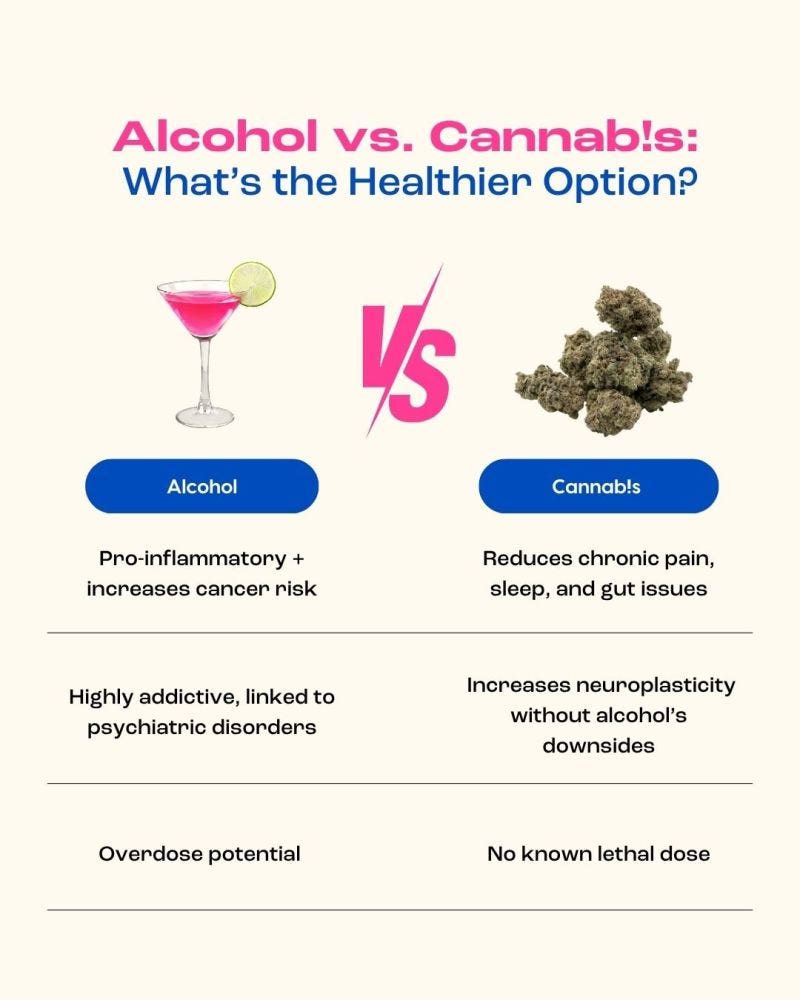
Cannabis and alcohol affect the body through fundamentally different mechanisms — and the difference in toxicity isn’t subtle.
Alcohol is a central nervous system depressant that is metabolized primarily by the liver. It affects virtually every organ system in the body. Ethanol crosses the blood-brain barrier rapidly, suppressing neural activity in the prefrontal cortex, cerebellum , and eventually the brainstem.
Chronic use damages the liver, pancreatitis, cardiovascular system, gastrointestinal tract, and immune system. The World Health Organization has classified alcohol as a Group 1 carcinogen, the same category as asbestos and tobacco, with established causal links to cancers of the mouth, throat, esophagus, liver, colon, and breast.
Cannabis primarily interacts with the body’s endocannabinoid system (ECS) — a network of receptors (CB1 and CB2) that regulate mood, pain, appetite, memory, and immune function.
THC binds to CB1 receptors concentrated in the brain, producing psychoactive effects including euphoria, altered perception, and appetite stimulation. CBD interacts with the ECS differently, modulating inflammation and anxiety without producing intoxication.
Cannabis does not suppress brainstem function, does not cause organ failure, and has no established lethal dose in humans.
The contrast in acute toxicity is stark.
Alcohol poisoning kills approximately 2,200 Americans annually through direct overdose. The lethal dose of alcohol — roughly 5 to 8 grams per kilogram of body weight — is achievable through binge drinking in a single session.
Cannabis, by contrast, has a theoretical lethal dose so extraordinarily high that no human death has ever been attributed to THC toxicity alone.
The DEA’s own administrative law judge, Francis Young, wrote in 1988 that marijuana “in its natural form is one of the safest therapeutically active substances known to man.”
Potential for Abuse and Addiction
Both substances carry addiction risk but the magnitude and severity differ dramatically.
Approximately 10-30% of regular alcohol users develop Alcohol Use Disorder (AUD), according to the National Institute on Alcohol Abuse and Alcoholism.
An estimated 29.5 million Americans aged 12 and older had AUD in 2023. Alcohol withdrawal is one of the few substance withdrawal syndromes that can be fatal — delirium tremens carries a mortality rate of up to 37% without treatment, with symptoms including seizures, hallucinations, and cardiovascular collapse.
Cannabis Use Disorder affects approximately 9-10% of regular users, according to NIDA — roughly one-third the rate of alcohol dependence.
The HHS scientific evaluation submitted to the DEA in 2023 found that marijuana’s abuse potential is “less than the drugs or other substances in schedules I and II” and that its withdrawal syndrome is “relatively mild compared to the withdrawal syndrome associated with alcohol.”
Cannabis withdrawal symptoms — irritability, sleep difficulties, decreased appetite — typically peak within two to six days and resolve within one to two weeks. Cannabis withdrawal has never caused a documented fatality.
The distinction matters for scheduling purposes.
The Controlled Substances Act defines Schedule I as reserved for substances with “a high potential for abuse” and “no currently accepted medical use.”
Even by the government’s own scientific assessment, cannabis fails both criteria — while alcohol, which has a higher abuse potential and no accepted medical use, remains entirely unscheduled.
Contribution to Crime: Violent and Non-Violent
The relationship between substance use and criminal behavior reveals perhaps the starkest contrast between alcohol and cannabis.
Alcohol is implicated in approximately 40% of all violent crimes in the United States, according to the Bureau of Justice Statistics.
Nearly half of all homicides and two-thirds of intimate partner violence involve alcohol consumption by the perpetrator. Alcohol-impaired driving kills approximately 13,000 Americans annually — roughly one person every 39 minutes.
The FBI’s Uniform Crime Report consistently identifies alcohol as the substance most associated with assault, sexual assault, domestic violence, and disorderly conduct.
Cannabis, by contrast, has consistently been associated with reduced aggression in pharmacological research.
A 2018 meta-analysis published in Psychopharmacology found that acute cannabis intoxication was associated with decreased aggressive behavior — the opposite of alcohol’s effect.
While impaired driving remains a legitimate concern with any intoxicant, the National Highway Traffic Safety Administration has found that cannabis-impaired drivers tend to drive more slowly, increase following distances, and take fewer risks — while alcohol-impaired drivers do the opposite.
The vast majority of cannabis-related criminal cases are for simple possession — non-violent offenses that, as the U.S. Sentencing Commission data shows, have been declining steadily as more states legalize.
Federal cannabis trafficking cases fell to just 383 in fiscal year 2025 — a 62% decline from 2021. By contrast, alcohol-related violent crime generates hundreds of thousands of arrests annually and costs the criminal justice system billions of dollars.
Overdose: The Ultimate Safety Metric
This is where the comparison becomes impossible to argue.
Alcohol is directly responsible for approximately 178,000 deaths annually in the United States, according to the CDC, making it the third-leading preventable cause of death behind tobacco and poor diet/physical inactivity. That figure includes alcohol poisoning, liver disease, alcohol-attributable cancers, and alcohol-impaired driving fatalities.
Cannabis has caused zero documented overdose deaths in recorded medical history. Zero. Not a reduced number. Not a declining trend. Zero.
The 2023 Drug Abuse Warning Network (DAWN) data cited by opponents of rescheduling notes that cannabis was documented in approximately 896,000 emergency department visits — slightly exceeding opioid-related visits.
But even the researchers acknowledge the clinical presentations differ substantially.
Cannabis-related ER visits are overwhelmingly for anxiety, paranoia, and nausea — symptoms that are uncomfortable but not life-threatening. Opioid-related visits frequently involve respiratory depression, unconsciousness, and death.
The Bottom Line
By every meaningful safety metric — acute toxicity, overdose potential, organ damage, addiction severity, withdrawal lethality, and contribution to violent crime — cannabis is demonstrably safer than alcohol.
This isn’t an opinion, it’s the conclusion supported by decades of pharmacological research, epidemiological data, and the federal government’s own scientific evaluations.
The opponents testifying at this week’s DEA hearing will argue that cannabis poses unacceptable risks to public health.
Some of those risks are real — particularly for adolescent users and pregnant women.
But the argument that cannabis warrants stricter federal control than a substance that kills 178,000 Americans annually, causes fatal withdrawals, is classified as a Group 1 carcinogen, and is implicated in 40% of violent crime is not a scientific position. It’s a political one.
The scheduling of controlled substances is supposed to be based on evidence.
The evidence has been clear for decades.
The only question is whether the system is finally willing to follow it.
This is Third-Party content and does not reflect (or not not reflect) the views of Cannabis Confidential or CB1 Capital.

Anthony Varrell is co-founder of Trade To Black and a thought leader in cannabis capital markets, government relations, and industry insights. Investing in public & private cannabis since 2014 via Stonebridge Partners.
 | A guest post by
|
Well, thanks for the refresher. Most of this has been generally known and scientifically supported for 60 years, but how does any of it get into the ALJ record when every single "expert" invited to testify is a prohibitionist who won't acknowledge the evidence?