

Summer Nuggets
U.S. cannabis marches toward the midterms.


Recent Recap, courtesy of Freddy Benson Gomes of ATB-Cormark
The administrative law judge (ALJ) hearing regarding the rescheduling of cannabis concluded yesterday. Participating parties will submit their final findings and post-hearing briefs to the ALJ.
The ALJ will then review the briefs and issue a recommended decision. While there is no statutory deadline for this, we expect the ALJ to move quickly.
Once the ALJ recommendation is issued, parties have 20 days to file formal exceptions before the file is officially transmitted to the DEA Administrator and the AG for a final decision. Note that the main purpose of those “formal exceptions” is to substantiate judicial litigation once a final ruling is published (see next step).
Once the final rescheduling order is signed, it will be published in the Federal Register. Under the Administrative Procedure Act, a final rule typically takes effect 30 days after publication. This 30-day window is when we expect prohibitionist groups to litigate the ruling and attempt to secure a judicial stay to block implementation.
We believe the risk of a judicial challenge successfully securing a permanent stay or overturning the decision is low (hard to handicap, but we would say 10-20%), given the administrative record being established.
Bottom line, considering the speed with which the interim AG has moved to advance this process and enforce tight procedural deadlines, we anticipate an accelerated schedule that could look like this:
Late July / Early August: ALJ issues the recommended decision.
Late August / Early Sept: The Attorney General / DEA issues the final ruling.
Late Sept / Early Oct: Rescheduling becomes officially effective.
^ assuming no judicial stays are granted.We think that the ALJ recommendation (which we expect will be favorable) could drive a positive market reaction, but we believe that a more meaningful re-rating would happen upon the final ruling. We believe most MSOs may move to uplist to major US exchanges in Q4/26 and Q1/27 following final rescheduling.
Consider that Tier 1 MSOs are trading at ~6.5x NTM EV/EBITDA. We think that full rescheduling could drive multiples to re-rate to +10x through lower cost of capital, gradual institutional capital involvement, and positive sentiment on further regulatory reform. We will update you as post-hearing developments happen.
Random Thoughts
Been adding VFF 0.00%↑, Vireo Growth, TRLV 0.00%↑, and Avicanna, of late.
^ we continue to believe VFF 0.00%↑ is too cheap as they’ve built a global footprint for their low cost high quality flower; this was a $20 stock in ‘21 and it is a much better company now with a stellar management team and a super-deep bench.
The MMJ “stay” decision could hit any day/week.
^ stay denied = fundamental positive.
As our space lays in wait, U.S. canna ETF MSOS 0.00%↑repeatedly tests the 200day.
Top Stories
The States Most Likely To Legalize Recreational Cannabis In 2027 And 2028
Did the Trump administration approve cannabis interstate commerce?
Veterans Deserve A Conversation On Legalizing Medical Cannabis
Cannabis Banking Needs A Law, Not More Guidance
Ohio Canna Sales +25.5% In First Three Mo. Following Intoxicating Hemp Ban
We Legalized Weed… So Why Does It Still Feel Broken?
New York’s War On Illicit Cannabis Makes Progress Upstate
What you need to know as Virginia approves legal recreational cannabis sales
Missouri’s Cannabis Market Grew Up Fast
Germany Bans Flower Reimbursement, Mandates Six-Month Trial for Extracts

Industry Headlines
Glass House Brands Announces Updated At-The-Market Distribution Program
Village Farms Unveils Super Toast Bites of Cannabis-Infused Gummies
Mack and Todd talk U.S. Cannabis on the AdvisorShares AlphaNooner
There’s a New Kid in Town (I don’t wanna hear it)
In full disclosure, I sit on the Board of C21 Investments, which recently entered into an agreement to be acquired by Vireo Growth, a rapidly growing and underappreciated player in the emerging U.S. cannabis landscape.
As a member of the C21 Special Committee, we were tasked with weighing bids from several of the top players in the space, and we unanimously chose Vireo Growth.
On Monday, I shared,
I had breakfast last week with Vireo Growth CEO John Mazarakis. It was the first time that I’ve had the opportunity to shake his hand. I left there pretty excited about what they’re building and how they’re building it.
I’ve described the C21 takeover as a screen pass that has beefy blockers ahead of a field of green. VREO isn’t just under-indexed by endemics, it’s well-positioned to flex when the remaining players in our circle do a 180-degree turn toward real money, who will do the math and sees a more fulsome picture.
Vireo is trading at less than 1x sales and 3x EBITDA, they’re integrating synergistic and accretive assets, and there are no signs that strategy will slow down.“Buy when there’s blood in the streets,” said a smart man once; Maz is doing just that.
Earlier this week, C21 Chairman Bruce Macdonald and Corp. Dev. Head Sammy “The J” Armenia—both of whom put the human in human capital—hosted an investor’s call for C21 shareholders. The purpose was to give shareholders a forum to discuss the deal, provide color on the strategic rationale, and answer any questions.
The event wasn’t recorded, but the comms below was shared in real-time.
C21 pursued M&A after recognizing that size was becoming critical for NYSE/NASDAQ uplisting, capital access, and operational efficiency as smaller operators were losing relevance.
Vireo was initially a long shot due to its checkered past with billion-dollar lawsuits and New York market struggles, but a meeting revealed entirely new leadership and a smart M&A-driven growth strategy.
John Mazarakis, former CEO of major sector lender Chicago Atlantic, brings deep capital access and sector leverage'; operators tend to give him a wide berth on transactions.
C21 is receiving ~4.5% equity in the combined entity based on Vireo’s announced M&A to-date, above its ~3.5% revenue and EBITDA contribution to Vireo’s proforma, effectively capturing integration synergy benefits upfront.
Vireo trades at 3–4x EBITDA versus select tier-one’s at 13–18x, offering a potential triple re-rate versus limited upside in already-premium-multiple names.
Sam joined Vireo as Director of Capital Markets, with a mandate to improve analyst coverage, investor awareness, and trading liquidity; a market maker has already been placed on the CSE, tightening spreads from 20–40% to 5–10 cents.
Vireo’s acquisition strategy targets capital-constrained, not distressed, businesses;
^ Deep Roots, Wholesome, Proper accretive per-share growth post-consolidation.
^ Nevada organic same-store sales grew double digits in a down market.
Three re-rate levers identified for Vireo:
closing the valuation gap to tier-one peers,
continued accretive M&A growth being missed by the market,
a sector-wide re-rate on federal regulatory catalysts including Schedule III rulemaking and the intoxicating hemp loophole closing in November.
The MSOS ETF is underweight Vireo at ~0.8% combined weighting despite it being a top-four revenue contributor; buying ~$100M notional would be needed to correct this, and MSOS has confirmed awareness of the gap.
Shareholder concerns about lock-up unlocks and share dilution were addressed;
^ internal Vireo stakeholders are not seeking exits.
^ John’s compensation agreement ties his pay to anti-dilutive, EBITDA-per-share, and liquidity metrics.Vireo’s “house of local operators” model preserves brand identity;
^ Silver State, Deep Roots, and others continue operating under their own names.
^ contrast vs. other Tier 1s rebranding approach.Uplisting is planned as evident by the recent share consolidation
Shareholder vote is targeted for around August 7.
^ proxy requires 66% approval, with board fully supportive;
^ CCB Nevada approval may be fast-tracked.
^ city/county transfer approvals could add 2–3 mo. as seen with South Reno store.Combined Nevada run rate of C21 and Deep Roots is ~$140M, making them the largest operator in the state.
^ consistent with stated strategy of $100M+ run rates in each state they enter.
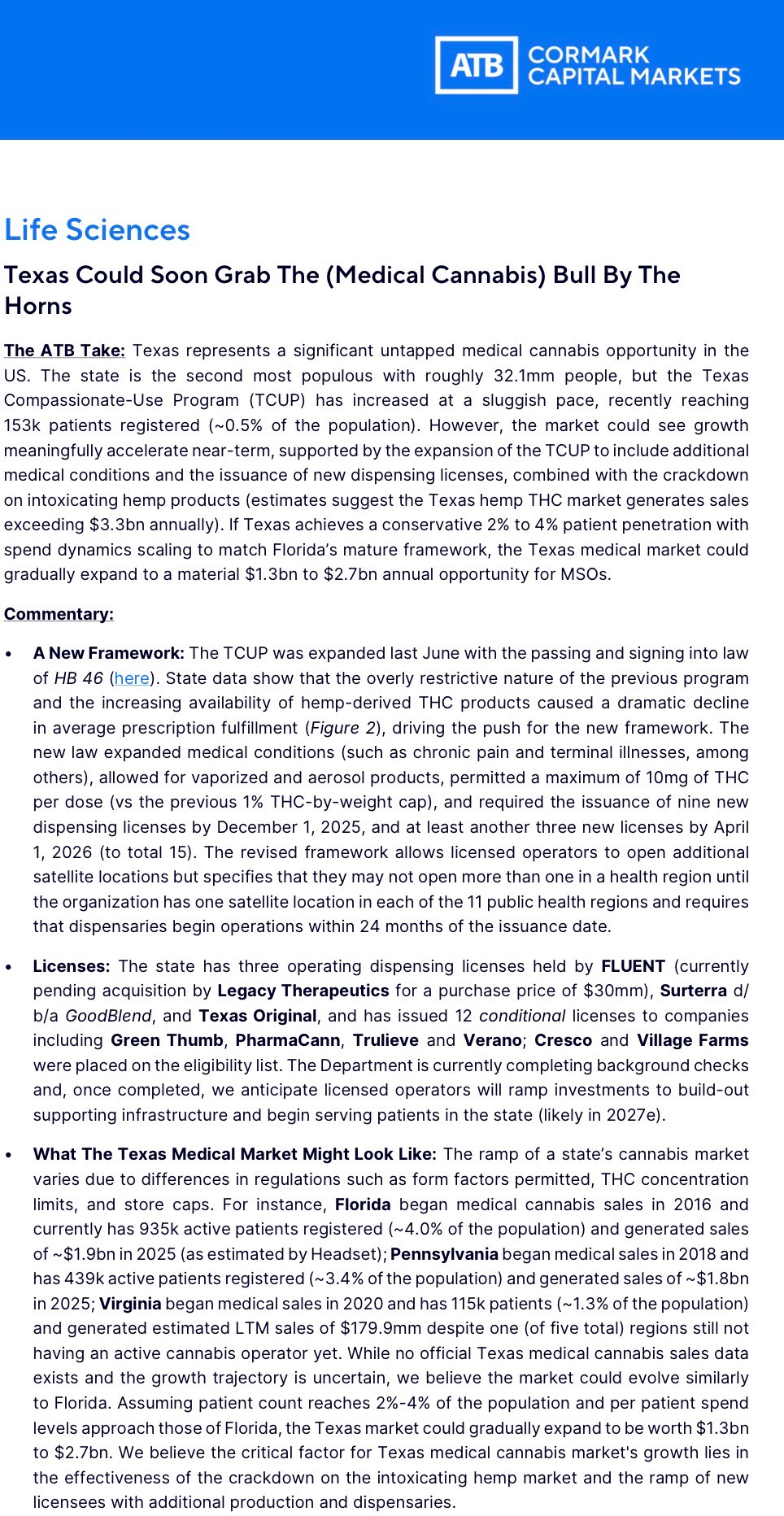
ATB: Texas Could Soon Grab The (Medical Cannabis) Bull By The Horns
Texas represents a significant untapped medical cannabis opportunity in the US. The state is the second most populous with roughly 32.1mm people, but the Texas Compassionate-Use Program (TCUP) has increased at a sluggish pace, recently reaching 153k patients registered (~0.5% of the population). However, the market could see growth meaningfully accelerate near-term, supported by the expansion of the TCUP to include additional medical conditions and the issuance of new dispensing licenses, combined with the crackdown on intoxicating hemp products (estimates suggest the Texas hemp THC market generates sales exceeding $3.3bn annually). If Texas achieves a conservative 2% to 4% patient penetration with spend dynamics scaling to match Florida’s mature framework, the Texas medical market could gradually expand to a material $1.3bn to $2.7bn annual opportunity for MSOs.
Stems & Seeds
Agitation in Dementia Can Be Helped by Medical Cannabis, Study Suggests

95% Of Healthcare Professionals Support Legal MMJ, 74% Would Recommend It

Review Explores How CB1 Signaling Connects Stress, Sleep And Eating Behavior

Have a safe journey, please enjoy responsibly.
If you’d like to help Mission [Green] change federal cannabis policies, please click here.
CB1 has positions in/ advises some of the companies mentioned and nothing contained herein should be considered advice.
Tedious, tedious, tedious. The process, Todd, not you. Should Blanche's nomination get derailed, more delays?