
Lights, Camera, Cannabis!
The normalization continues as consolidation begins.


Recent Recap
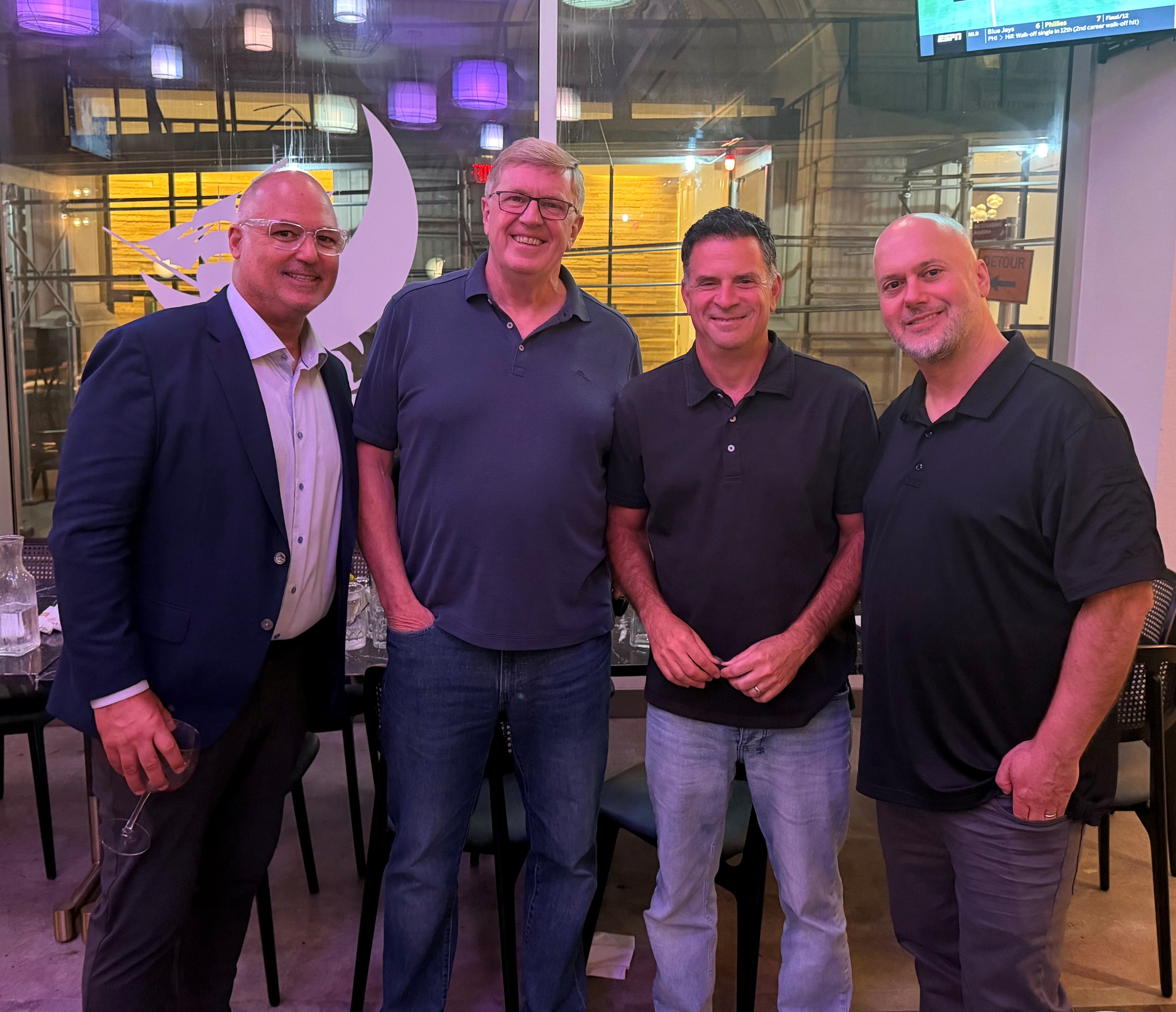
This past weekend, on a balmy August Sunday in the financial district, AdvisorShares hosted their team and a slew of cannabis industry leaders for a low-key downtown dinner, where we got to see some old friends, which is always good for the soul.
Monday morning was a historic day on Wall Street as AdvisorShares, the manager of the U.S. cannabis ETF MSOS 0.00%↑, rang the opening bell on the NYSE, bridging the two world’s that I’ve been trying to connect for more than 15 years.
The milestone is largely symbolic but it dovetails into perhaps the most consequential stretch in the history of this quickly emerging consumer segment, one that’s seen THC consumption skyrocket with demand that’s been split between the regulated market and a pernicious yet persistent intoxicating hemp complex.
Speaking of which, at 2:34 AM Saturday morning, the U.S. Senate approved a bill that would delay a federal ban on intoxicating hemp. Why? Per Curaleaf CEO Boris Jordan, the Senate needed Dem votes to pass the C.R. and they used this issue to grab them.
Per BoJo, the hemp lobby tried for a one-year delay, then six-months, and settled for one-month with hopes that 1. it’ll pass the House, which is far from given, per Jushi’s Trent Woloveck, and 2. it’ll allow time for a few “adjustments,” whether that’s for ‘full spectrum’ CBD (for Howard Kessler) or a possible probable beverage carve-out.
^ during last week’s earnings calls, GTI’s Ben Kovler offered, “We’re optimistic this transition will carve out a lasting place for THC beverages in the mainstream market” and BoJo said, “Organic growth next year could be 10-15% on the back of inhalable hemp shutdown,” and there is “zero risk of an extension beyond December 11.”
How this plays out remains to be seen but one thing’s for certain: there’s a lot going on in the cannabis complex, which I did my level best to communicate to my pal of 20-odd years Charles Payne on Fox Business yesterday afternoon.
This morning, the long-awaited consolidation took a giant step forward when Curaleaf made a bid for Aurora Cannabis in an attempt to increase EU-GMP certified capacity.
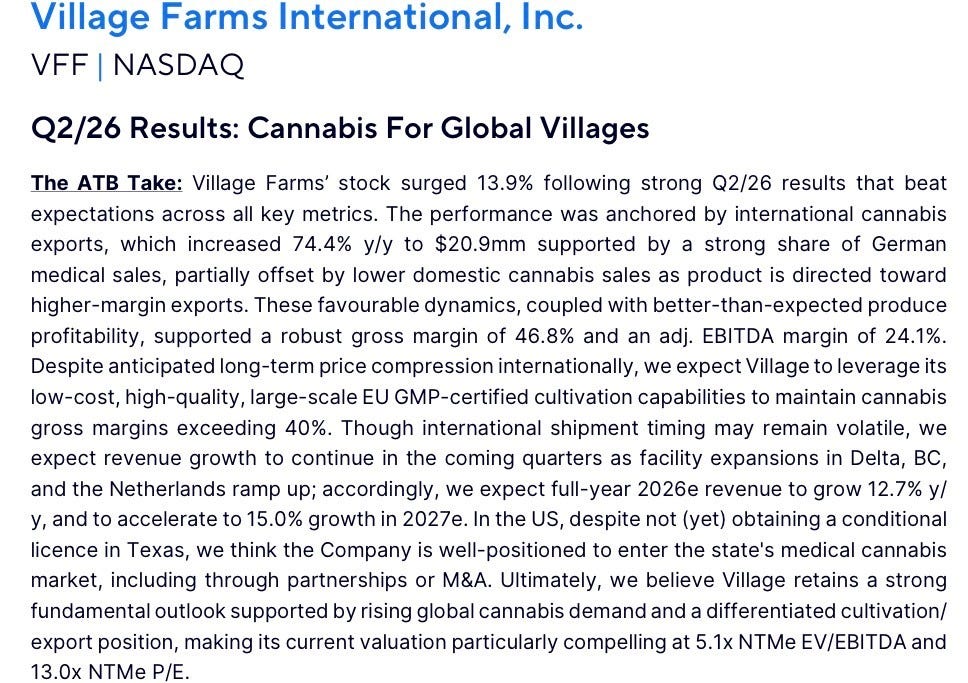
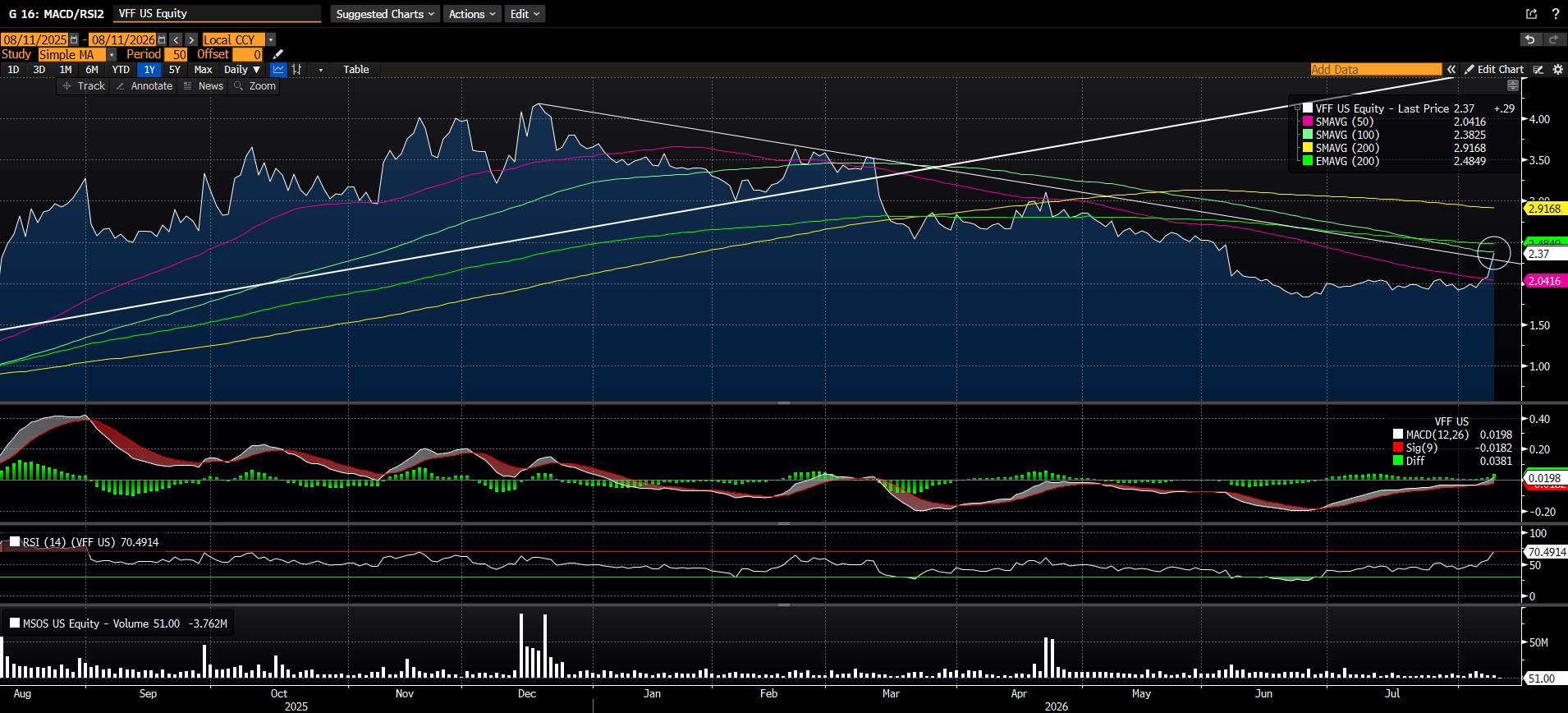
We haven’t been shy when talking about the advantageous risk-reward in VFF 0.00%↑anywhere near $2 and as MSOS rang the NYSE 🛎️, Captain Mike and his rather deep bench were delivering another outstanding quarter ICYMI.
If EU-GMP certified capacity is in play, Village sits at that pole position.
ATB on Village Farms; “Outperform, $4.50 PT”
Top Stories
U.S. Senate Approves Bill That Would Delay Federal Hemp Restrictions
Bipartisan Bill Would Establish Federal Rules for Hemp THC Beverages
SAFE Banking Act Gains Four New Bipartisan Senate Sponsors
Big Alcohol And Tobacco’s Anti-Cannabis Playbook Is Failing
Ohio Canna Sales Surpass $4 Billion Including $1.67 Billion In Adult-Use
Florida MMJ Sales Reach Record $198 Million In July, Near $1.2 Billion In 2026
Alcohol Lost Gen Z, Millennials, Gen X. Cannabis Smears Won’t Win Them Back

Industry Headlines
Vireo Growth Announces a Four-Deal Transaction to Establish Presence in Ohio
ATB on U.S. cannabis earnings
We’re midway through earnings season for US cannabis MSOs, and the overarching takeaway so far is encouraging: companies are back to growing revenue.
Over the past years, MSOs have faced price compression, competition from intoxicating hemp products, and retail saturation in key markets that eroded per-store sales. Management teams have adapted by tightening cost structures to offset operating deleverage, exiting non-core markets, and focusing on increased operating efficiency with improvements in cultivation yields, quality, and consistency.
Considering the headwinds we’ve seen across markets, we believe MSO margins have actually held up remarkably well. However, sales have suffered as increasing volumes haven’t been enough to offset price compression.
Now, while price compression and retail competition remain headwinds, MSOs are showing a return to revenue growth. We think these results are very constructive and could indicate the beginning of market conditions stabilizing.
This stabilization is likely due to a combination of factors, including consolidation (with unprofitable players exiting or selling), more rationalized supply (as a result of more discipline capital allocation and tight capital availability), pricing nearing a floor in certain states (slowing the rate of decline), and more recently the early state-level enforcement against intoxicating hemp (with Ohio as a prime example).
Accordingly, heading into next year we believe that the federal intoxicating hemp ban becoming effective (and enforced) is crucial for the industry to maintain a strong revenue growth trend.
Back to earnings, here’s how we think the scorecard looks so far:
Positive
Curaleaf: Revenue +9.5% y/y (Domestic +7.1%, International +25.7%). Adj. EBITDA came in at $70.1M vs. $66.1M consensus, yielding a 20.6% margin vs. 19.9% consensus.
Cresco: Revenue +5.9% y/y. Adj. EBITDA came in at $39.5M vs. $35.4M consensus, yielding a 22.8% margin vs. 21.3% consensus.
Jushi: Revenue +9.6% y/y. Adj. EBITDA came in at $13.3M vs. $11.9M consensus, yielding an 18.7% margin vs. 17.7% consensus.
Mixed
Green Thumb: Revenue +4.6% y/y. Adj. EBITDA came in at $68.6M vs. $78.7M consensus. Normalized EBITDA (adding back licensing fees) was $84.3M (27.5% margin), missing our estimate of $92.8M (31.1% margin). Despite the margin miss, Green Thumb is still our top pick.
Verano: Revenue +7.7% y/y. Adj. EBITDA came in at $51.2M vs. $50.6M consensus, yielding a 23.5% margin vs. 24.2% consensus.
Stems & Seeds
THC Eliminated Nightmares For Over A Third Of PTSD Patients In German Trial

Cannabinoids Significantly Improve Insomnia, Sleep Quality And Duration
Have a safe journey, please enjoy responsibly.
If you’d like to help Mission [Green] change federal cannabis policies, please click here.
CB1 has positions in/ advises some of the companies mentioned and nothing contained herein should be considered advice.